


SeaSational Summer is a holistic summer campaign developed in response to how leisure travellers now use digital media to decide when and where to travel. Rather than approaching summer promotion as a short-term activation, the campaign was structured as a season-long digital system informed by global market research, traveller behaviour studies, and evolving best practice in destination marketing.
Drawing on leading international research into digital travel behaviour, the campaign framework reflects the distinct roles played by social platforms, search, video, AI-assisted planning tools, and official destination channels in the modern travel decision journey. Particular emphasis was placed on understanding how confidence is built over time, how seasonality perceptions are shaped digitally, and how visible activity and momentum reduce hesitation around summer and shoulder-season travel.
This article outlines the evidence-led thinking behind SeaSational Summer, explaining how global research, observed digital behaviour, and destination marketing strategy converge into a cohesive framework for building sustained summer demand for the Maldives.
Why digital momentum matters now
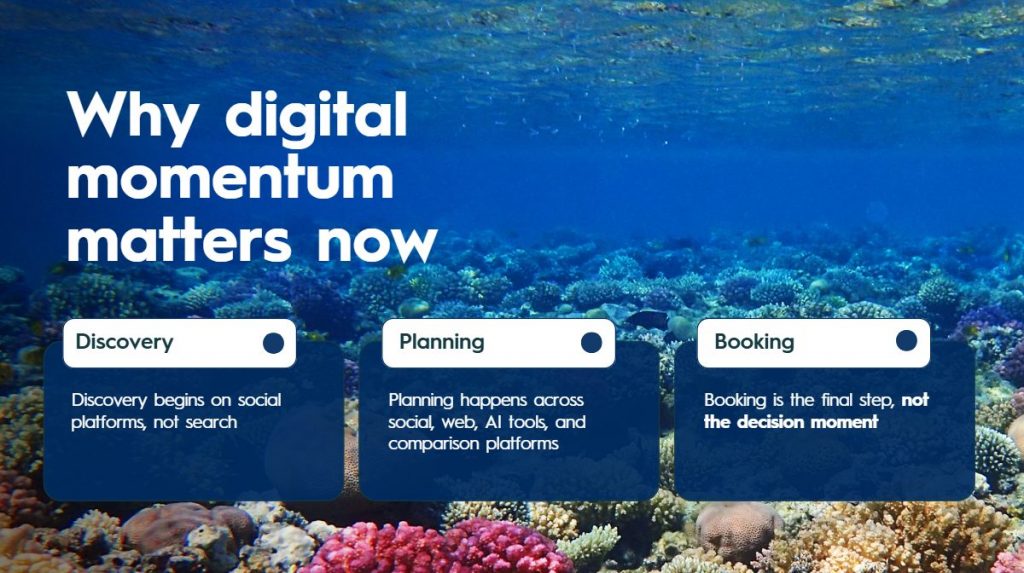
Multiple industry studies now agree on one central shift: travel decisions are no longer driven by short, high-impact campaign moments. They are shaped by continuous digital exposure over time.
Phocuswright’s 2025 research shows that leisure travellers, particularly those travelling long-haul or outside peak seasons, move through extended consideration cycles, revisiting destinations digitally before committing. Expedia Group’s 2025 Traveller Value Index reports that over 60 percent of consumers cite social media as a source of travel inspiration, up from 35 percent in 2023, indicating that exposure begins earlier and lasts longer than before.
McKinsey’s tourism analysis adds an important dimension to this shift. It notes that around 20 percent of travellers in 2025 choose trips based on live events or destination activity, particularly in shoulder seasons, because visible activity reduces uncertainty around timing.
Together, these findings reinforce a critical point. Digital marketing today is not about visibility alone. It functions as demand architecture, shaping confidence, legitimacy, and timing well before booking occurs.
How travellers used digital media in 2025
Across global research from Phocuswright, Amadeus, Agoda,and HBX Group, a consistent behavioural pattern emerges.
Social media has become the dominant entry point for destination discovery. HBX Group’s 2026 Travel Trend Report finds that 76 percent of travellers post about their experiences on social media, reinforcing travel as social currency, while 72 percent say booking decisions are influenced by influencer or blogger content. Short-form video, in particular, plays a decisive role in early-stage desire.
However, inspiration alone does not drive conversion. Studies show that travellers move fluidly between platforms. Amadeus reports that 34 percent of travellers in the United States now use social media for travel inspiration, a figure that has grown year on year across Gen X and Millennial segments. At the same time, research highlights a growing reliance on AI-assisted planning. HBX Group estimates that around 40 percent of travellers worldwide already use AI tools for trip planning, with 62 percent of Millennials and Gen Z in key markets actively using generative AI for discovery and itinerary building.
Agoda’s 2026 Travel Outlook further underscores this shift in Asia, where 63 percent of Asian travellers say they are likely to use AI to plan their next trip, and 44 percent express trust in AI-generated travel information.
Despite these changes, trust remains selective. Amadeus and Phocuswright consistently find that while social platforms and AI accelerate discovery and comparison, they do not replace authoritative validation.
The role of official destination platforms
Official destination platforms occupy a distinct position in this ecosystem. They are rarely the first touchpoint, but they are among the most trusted during the planning and confirmation stages.
Phocuswright’s 2025 findings show that over 65 percent of leisure travellers visit an official destination website during the planning phase, particularly when travelling long-haul, booking high-value trips, or travelling in unfamiliar or non-peak seasons. In trust rankings, destination management organisation websites consistently place among the top three most trusted sources, above influencers and OTAs, though below personal recommendations.
Amadeus research adds that travellers increasingly turn to destination websites to confirm feasibility, seasonality, safety, and suitability, after being inspired on social platforms. Agoda’s outlook report similarly notes that travellers cross-check weather narratives, events, and experiences on official destination platforms even when they intend to book through OTAs.
In practical terms, travellers visit official destination websites to answer a single question: does this make sense for me now?
How Visit Maldives’ digital performance aligns with global trends
Rather than treating digital analytics as surface-level performance indicators, Visit Maldives assessed its digital ecosystem through the lens of traveller behaviour identified in global research. The patterns observed across platforms closely mirror how travellers are now known to move from inspiration to decision-making.
High-volume visual platforms perform a clear awareness and consideration role. Visit Maldives’ presence on platforms such as Instagram and Facebook consistently delivers multi-million-level reach and video views, confirming their function as discovery and shortlisting environments rather than conversion endpoints. These platforms are where travellers repeatedly encounter the destination, save content, and mentally position the Maldives within their travel consideration set, a behaviour widely documented in Phocuswright and Expedia Group studies.
Short-form video platforms play a distinct role in accelerating cultural relevance. Content distributed through TikTok achieves rapid visibility and repeat exposure, reinforcing destination presence within trend-driven discovery cycles. This aligns with global findings that short-form video increasingly influences when travel feels appropriate, particularly for seasonal travel decisions, even when direct conversion is not the objective.
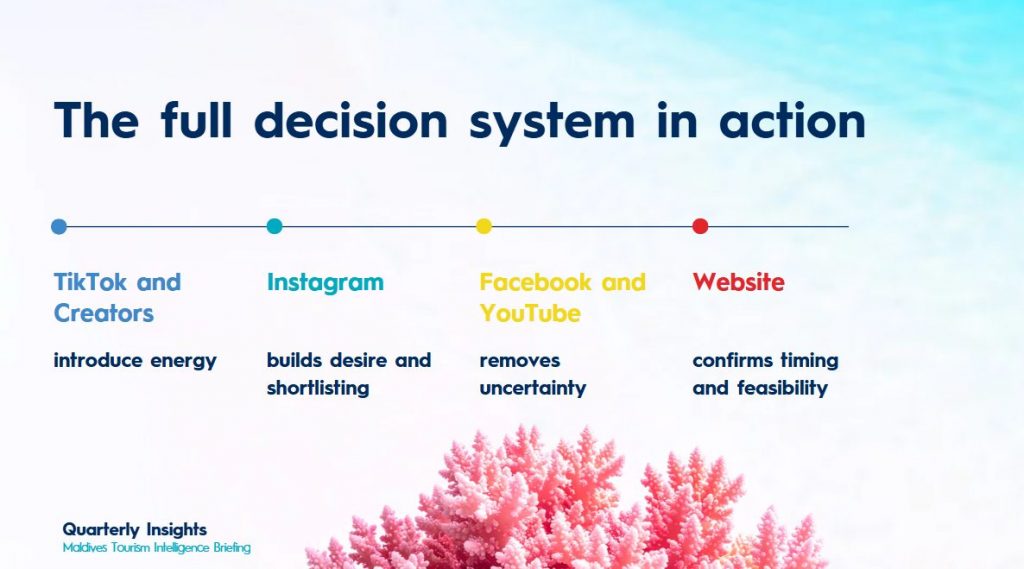
Longer-form video platforms support depth and conviction. Visit Maldives’ video content distributed through YouTube consistently reaches audiences at scale and sustains engagement beyond peak travel periods. This behaviour reflects YouTube’s established role, identified by multiple studies, as a learning and validation platform where travellers seek reassurance, context, and narrative coherence before committing to long-haul travel.
Official destination channels and the website function as stabilising reference points. Rather than competing with social platforms for reach, they absorb intent generated elsewhere and provide clarity around experiences, timing, and feasibility. This role is consistent with Phocuswright and Amadeus research, which places official destination platforms among the most trusted sources during the planning phase, particularly for high-value and non-peak travel.
Viewed together, Visit Maldives’ digital performance demonstrates alignment rather than fragmentation. Each platform performs a defined psychological function, contributing to a system where confidence is built progressively through repetition, authority, and visible activity.
Events as confidence accelerators
One of the strongest signals across the research relates to events and visible activity.
Phocuswright reports that travellers are more likely to commit to travel when they see time-bound cultural or lifestyle activity associated with a destination, even if they do not plan to attend the event themselves. McKinsey similarly notes that destination activity calendars reduce “decision friction”, particularly for shoulder seasons.
This reframes events from tactical activations into conversion support assets. Visibility, not attendance, is what legitimises timing.
How this comes together in SeaSational Summer
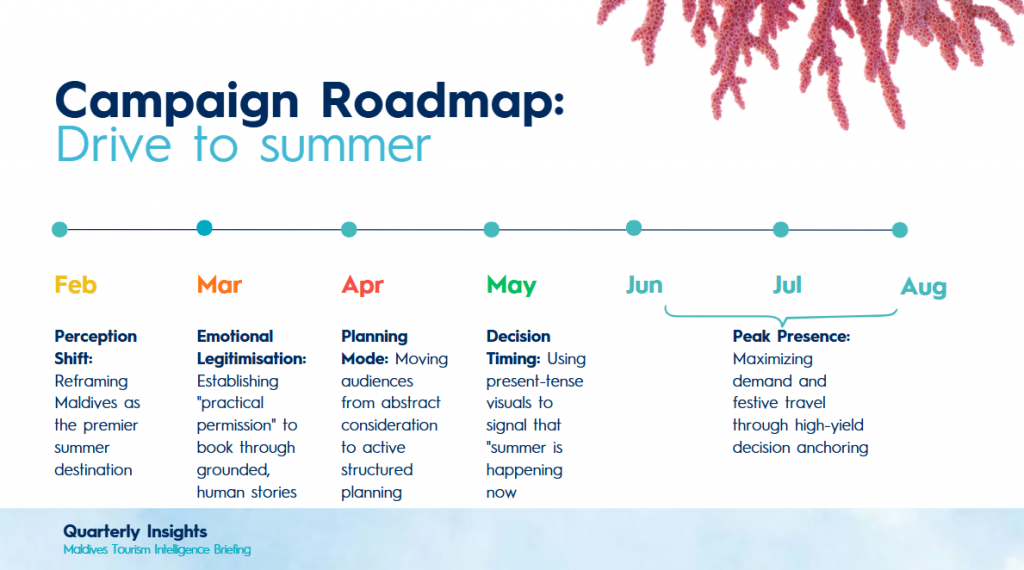
SeaSational Summer was designed as a seasonal system, not a short-term campaign. Its structure reflects both observed traveller behaviour and the functional roles played by different digital platforms.
Rather than concentrating activity into isolated bursts, the campaign builds momentum deliberately from February through August. Early months focus on establishing perception and permission, using high-reach visual platforms to normalise summer travel to the Maldives and to reframe seasonality through repeated exposure. This phase aligns with research showing that travel confidence is shaped well before booking windows open.
As the season progresses, content emphasis shifts towards validation and reassurance. Longer-form video, narrative-led social content, and authoritative destination messaging reinforce the idea that summer is not only viable, but active and desirable. This is supported by the increasing visibility of experiences, partner activity, and destination-wide storytelling across Visit Maldives’ owned platforms.
Central to this system is the Visit Maldives Events Calendar, now branded under the SeaSational Summer framework. The calendar functions not as a passive listing tool, but as a credibility layer. Research consistently shows that visible activity reduces decision friction, even for travellers who do not attend events themselves. By showcasing a steady rhythm of events and experiences, the calendar signals that summer is planned, participated in, and supported by the wider industry.
Throughout the season, Visit Maldives–produced content plays a coordinating role. It connects partner activity, events, and destination narratives into a cohesive digital presence that sustains confidence over time. The result is not a single promotional moment, but a cumulative effect where exposure, reassurance, and validation work together to support late-summer and shoulder-season demand.
Industry alignment, collective participation, and shared momentum
SeaSational Summer is designed to be industry-wide by intent.
Visit Maldives invites partners to contribute by sharing events through the official Events Calendar, aligning press releases with seasonal narratives, and providing strong visual assets such as images and videos that can be amplified across digital platforms. Content collaborations and hosted content trips allow Visit Maldives’ creative teams to work alongside partners to tell cohesive stories that serve both destination and individual brand objectives.
Research consistently shows that when destination platforms and industry partners align, demand creation becomes collective rather than fragmented.
SeaSational Summer represents a shift from campaign-led visibility to system-led demand building, grounded in evidence rather than assumption. By aligning digital platforms according to their natural behavioural roles, sustaining momentum over time, and positioning events and visible activity as confidence signals, the approach reflects how travel decisions are actually formed in today’s digital environment.
Designed by the Visit Maldives Digital Marketing Department, SeaSational Summer was presented to industry leaders and marketing peers by the department’s Creative Director Ahmed Afruh Rasheed, at the Visit Maldives Quarterly Insights – Maldives Tourism Intelligence Briefing on 02 February 2026. The framework reinforces the importance of industry alignment, collective participation, and shared momentum in shaping summer and shoulder-season travel demand.