



The global context: Demand held, and value strengthened
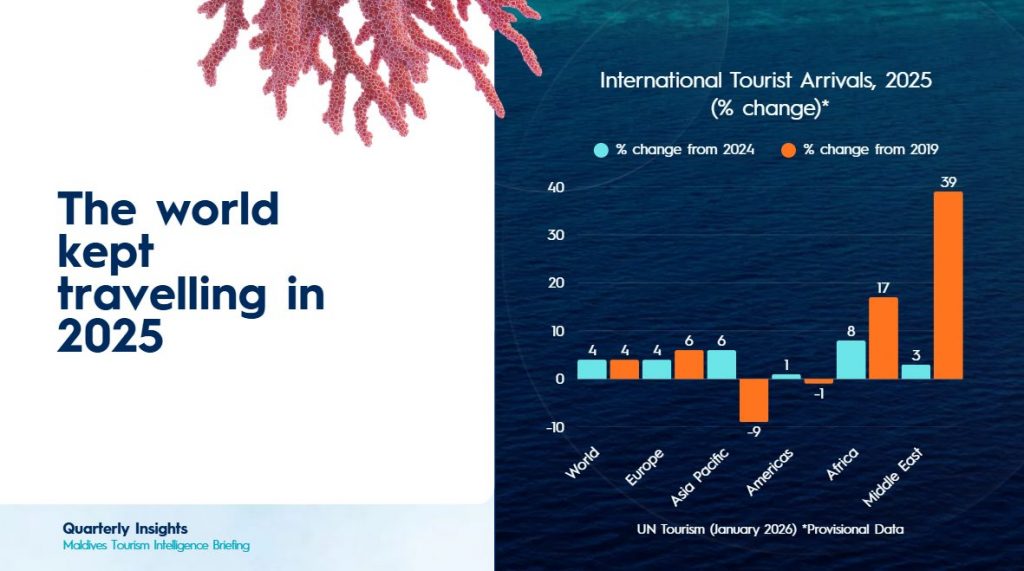
The global headline for 2025 was clear: the world kept travelling and demand remained resilient. International tourist arrivals grew by 4% in 2025 to reach an estimated 1.52 billion travellers, reinforcing that the industry has moved beyond recovery and is now returning to a steadier growth pattern. What matters just as much is the value picture. International tourism receipts were estimated at USD 1.9 trillion, indicating that demand in 2025 was not only higher in volume, but also strong in value.
2026 Outlook
Looking ahead, the outlook for 2026 is cautiously positive. UN Tourism expects growth to continue in the range of 3% to 4%, shaped by a familiar set of drivers and risks:
- Easing inflation in travel services.
- Improving air connectivity.
- Ongoing uncertainty from geopolitical tensions and cost pressures.
The Bottom Line: Momentum is expected to continue, but it will be a more competitive conversion environment.
Maldives performance: Strong close to 2025, solid start to 2026
Against that global backdrop, the Maldives delivered a strong performance in 2025. We welcomed 2,246,516 visitors, representing 9.8% year-on-year growth. This comfortably outpaced the global average and reinforces our destination’s competitiveness.
Recent Momentum
- December 2025: 224,455 arrivals (↑ 7.4% YoY)
- January 2026: 224,788 arrivals (↑ 4.6% YoY)
- Market Mix & Regional Shifts
Demand health: The quality signals behind the headline
Headline arrivals matter, but the health of demand is best understood through quality indicators: how long visitors stay and how well capacity is utilized.
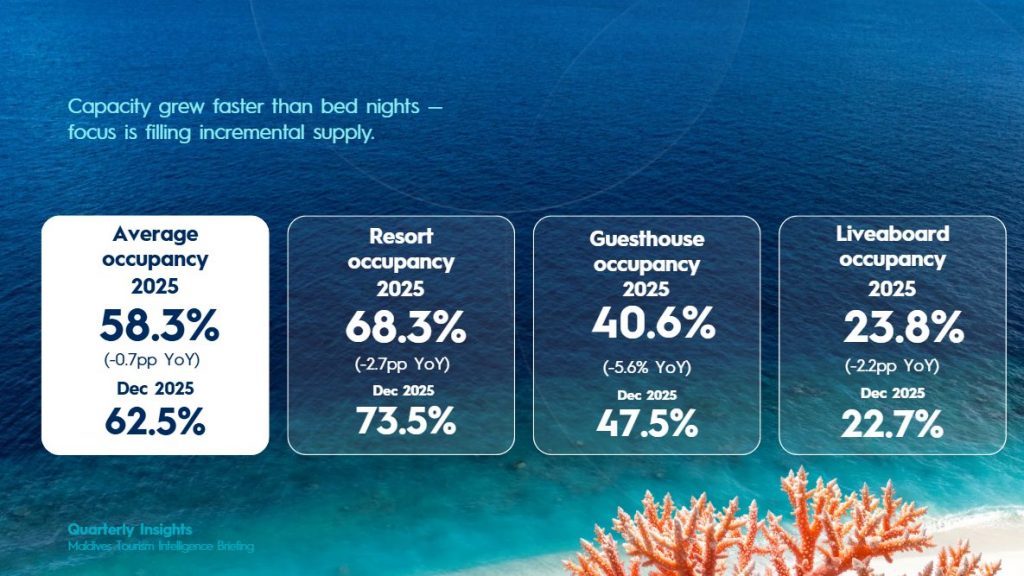
The Supply-Demand Dynamic: In 2025, Maldives recorded 13.67 million bed nights (↑ 2.4%). However, average beds in operation increased to 64,377 (↑ 4.3%).
The Implication: Capacity expanded faster than bed nights. The next stage is about filling incremental supply more efficiently across the year.
Occupancy & Length of Stay
- Average Stay (2025): 6.97 days (down 5.6% YoY), though December saw an improvement to 7.2 days.
- Overall Occupancy: 58.3% for 2025.
Performance by Segment:
- Resorts: 68.3% annual occupancy (73.5% December peak).
- Guesthouses: A clear bright spot at 40.6% (↑ 5.2 percentage points).
- Liveaboards: Remained softer at 23.8%
Forward indicators: Airlift outlook and conversion priorities
For the Maldives, airlift remains the most predictive forward indicator. For February to June 2026, scheduled inbound seats are forecast at 1.61 million (↑ 5.1% YoY).
The Seasonal Shift:
- March: Peak capacity at 369.8k seats.
- June: Steps down to 279.2k seats.
- Route Dynamics: Direct Europe share declines (12.3% in Feb to 1.6% in June), while GCC hub share increases (38.6% in Feb to 45.7% in June).
Practical next steps (90-180 days)
The immediate playbook for Q1 and Q2 is clear:
- Maximize the March Peak: Push conversion where seat capacity is strongest.
- Protect May/June Performance: Shift emphasis to hub-led corridors (DXB, DOH, AUH) and South Asia/Asia recovery markets.
- Airlift Strategy: Build airline-by-airline seat-fill plans with the top 10 carriers who control 66% of capacity.
At a glance
- Global: +4% arrivals; USD 1.9 trillion receipts.
- Maldives: +9.8% YoY growth in 2025; momentum sustained in Jan 2026 (+4.6%).
- Critical Factor: Capacity is outgrowing bed nights; utilization is the 2026 priority.
- Strategy: Focus on hub-led flows and conversion discipline as we enter the shoulder period.
Sources: UN Tourism World Tourism Barometer (Jan 2026); Ministry of Tourism & Environment reporting (Dec 2025; Jan 2026); MACL seat forecast (Feb-Jun 2026).
Comments are closed.