



Europe: The strategic backbone
Reflecting on recent performance, Europe continues to be the primary anchor for arrivals, holding a dominant 59% share of the total market. In 2025, the region delivered over 1.33 million tourists, a testament to its enduring connection to the Maldives. This represents a strong 10.4% year-on-year growth, fueled by steady contributions from a broad base of major markets including Russia, the UK, Germany, Italy, and France. These numbers underscore that Europe isn’t just a volume market; it is the essential foundation for our industry’s stability.
However, the way Europeans travel is evolving in 2026. We are seeing a distinct shift toward the “smart shoulder season,” with one in five travelers now opting for September and autumn over the traditional August peak in search of a calmer experience. There is also a growing appetite for the unknown; more than half of travelers are looking beyond traditional hotspots to discover off-the-beaten-path locations, while 62% are prioritizing sustainability and responsible travel.
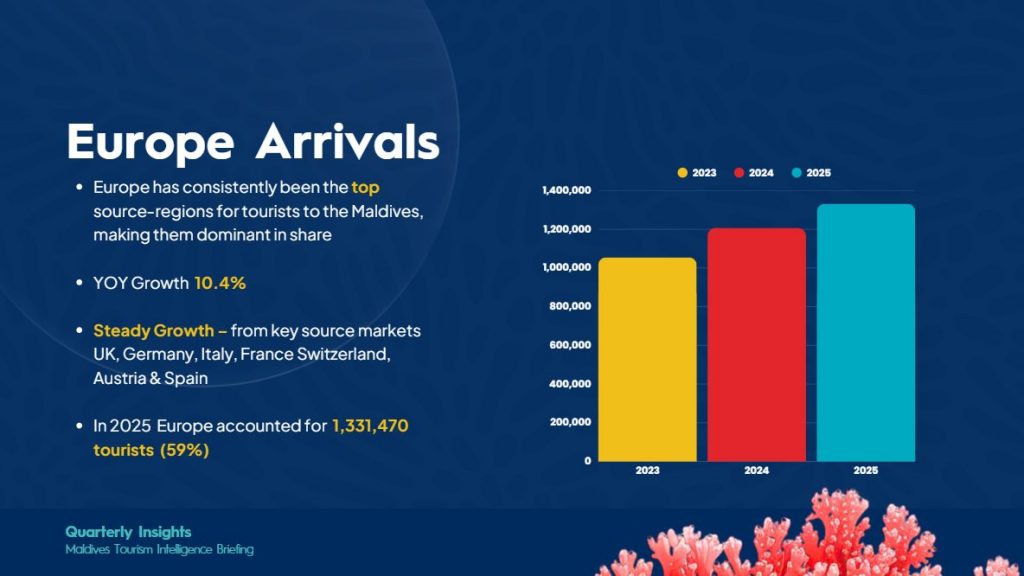
The planning data reveals fascinating cultural nuances. Russia remains our most consistent year-round market, whereas Italy and the UK enjoy extended seasonal peaks of up to seven months. In contrast, German travelers are the ultimate planners, booking an average of 104 days in advance and staying for over 11 days. Whether it is the digital influence of Instagram—which 67% of Europeans use to decide their destination—or the continued trust in human-first guidance for safety, the European market remains a highly sophisticated landscape where visual storytelling and personalized service are key.
APAC: The high-growth engine
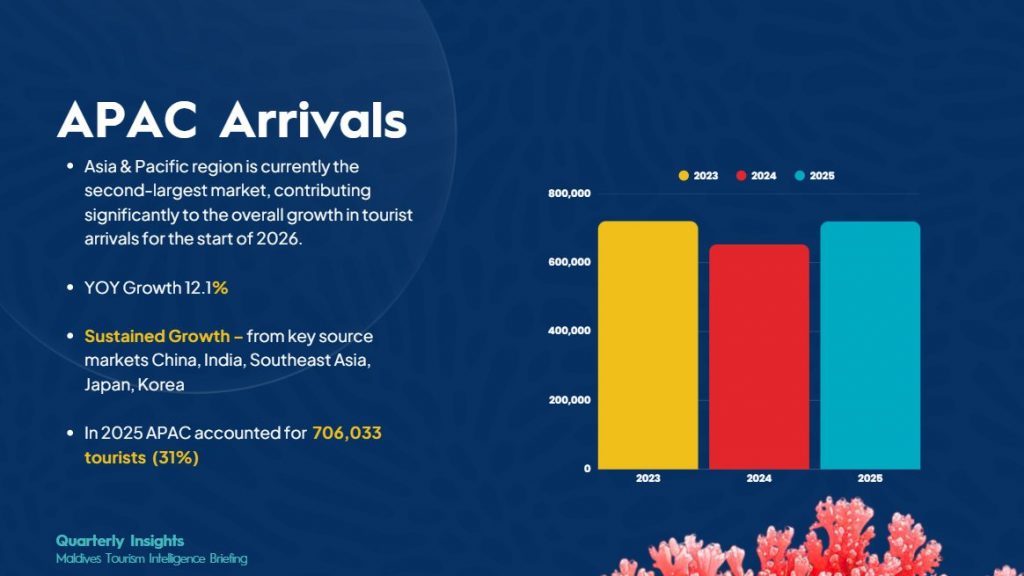
The Asia-Pacific region has emerged as a critical growth driver as we move into 2026. Currently our second-largest source market, APAC contributed 706,033 tourists in 2025—roughly 31% of total arrivals. With a year-on-year growth rate of 12.1%, the region is a strategic powerhouse for long-term diversification, led by momentum in China, India, Southeast Asia, and Korea.
A defining factor for 2026 is the return of China as a global outbound force. Projections suggest that Chinese outbound travel will surpass pre-pandemic levels by up to 13% this year. This growth is being funneled through major regional hubs like Singapore, Bangkok, and Tokyo, which play a vital role in channeling travelers toward our islands. To capture this, we are looking beyond gateway cities and targeting “Tier-2” and “Tier-3” locations where direct connectivity is increasing.
The APAC traveler is increasingly motivated by “meaningful moments.” We are seeing a sharp rise in purpose-driven trips, such as wellness retreats and “work-from-anywhere” stays. This audience is also heavily influenced by “screen-to-sea” inspiration; 70% of travelers find their wanderlust through video content, particularly film and television. In markets like Malaysia, this influence is staggering, with 91% of travelers crediting media for their plans. By aligning our offerings with these immersive, media-driven motivations, we can deepen engagement across this dynamic region.
Middle East & GCC: Quality and luxury
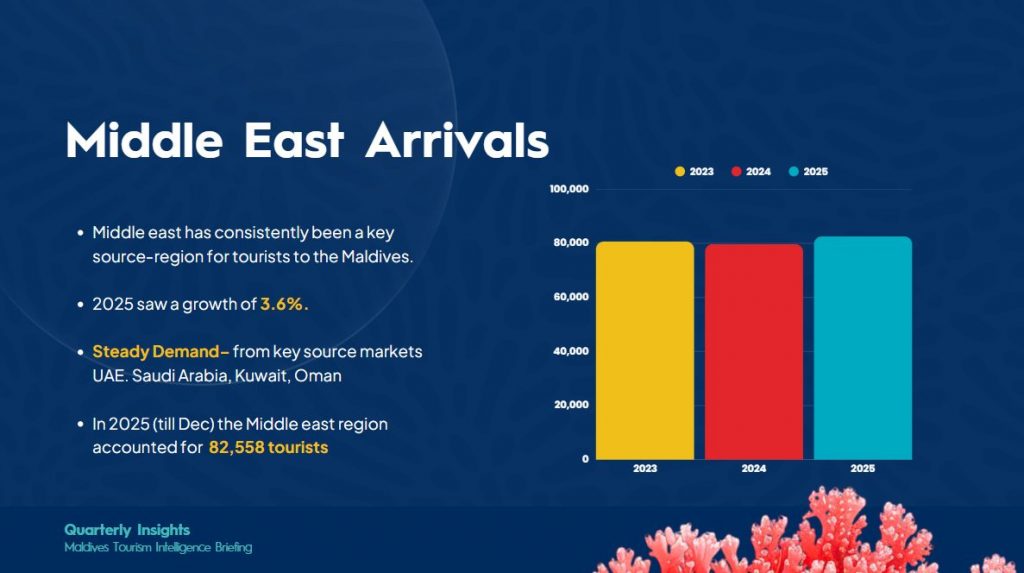
The Middle East continues to be a high-value corridor for the Maldives, characterized by a preference for premium hospitality and geographic proximity. In 2025, the region grew by 3.6%, delivering 82,558 arrivals by year-end. While the volume is smaller than Europe, the “quality of business” is exceptionally high. These travelers often arrive in large family groups, stay longer, and invest heavily in premium services such as private yachts, villa upgrades, and exclusive wellness activities.
There is a clear evolution toward experience-driven travel in the GCC. Roughly 68% of travelers now choose their trips based on cultural or sporting experiences rather than just leisure. They want enrichment and adventure, which is driving a new trend of “multi-destination” itineraries. Around 52% of Middle Eastern travelers now express a desire to explore multiple locations in a single journey, seeking a diverse mix of environments and activities.
Technologically, this market is among the most advanced. Sixty percent of travelers rely on AI tools and travel apps to build their itineraries long before they book. They are looking for “Lux-scaping”—the practice of adding specific luxury touchpoints to an otherwise standard trip to create moments of indulgence. For the Maldives, the takeaway is clear: this market values engagement and storytelling. To succeed here, we must sell more than just a room; we must sell unique memories supported by a seamless digital experience.
Key Takeaways
The Maldives is perfectly positioned to capture high-value travelers across all three regions. Europe provides the stability of long stays and sustainability; APAC offers high-growth potential through media-driven inspiration; and the Middle East remains our premium anchor for luxury and family travel. By tailoring our strategy to these specific regional behaviors, we can ensure a resilient and profitable 2026.
Comments are closed.